HPCR – Who Is Affected?
Whether we are aware of it or not, we all know people who used to be homeless. We all know people who will be homeless. It could even be us. It’s interesting to ponder on the people who have experienced homelessness at some point in their lives.
The life of a recently deceased millionaire computer genius Steve Jobs had a precarious beginning, as described by Ivana Kvesic:
Jobs ultimately decided to drop out of Reed College and did so because he trusted that ‘it would all work out ok.’ However, during this process, Jobs became homeless. As a Reed drop out, Jobs did not have a dorm room and slept on the floor of his friends’ dormitories. Being a homeless and unemployed student required Jobs to return coke bottles to earn money for food and walk seven miles across town to get a free meal once a week at the Hare Krishna temple.
British author Colin Wilson was one of the “angry young men,” the creative yet alienated generation whose influence led to what we call the Sixties. After the 1956 publication of The Outsiders, he was recognized as the foremost philosopher of phenomenological existentialism, and went on to a prolific career as a writer of both fiction and nonfiction. Before The Outsiders, he was just another young bum, by night sleeping rough in one of London’s parks, by day working on his manuscript in the reading room of the British Museum.
Vietnam veteran and multi-book author Bruce Goldwell was homeless in Los Angeles for more than nine years. He is quoted as saying,
To have gone from living in an alley behind Dennis Hopper’s house to now having a book published in another country felt like such a different direction for me. I was no longer falling deeper into despair but climbing the ladder to a whole new level of success.
In the November 2005 issue of Smithsonian Magazine (which is not online), Roy Rowan profiled photographer Gordon Parks as one of the 35 people who made a difference in the world. When Parks was 16, his mother died, and he stayed only a short time with his sister before, as Rowan says,
Her hard-boiled husband soon kicked him out of the house, forcing Gordon to spend his nights riding trolley cars back and forth… and scrounging food to continue going to high school.
Today, thousands and thousands of kids are in that kind of situation, and not all of them are so lucky in finding places to spend the night. (Incidentally, Ben Franklin, whose portrait is on the $100 bill, was a 17-year-old runaway.)
After his first self-produced stage play failed, Tyler Perry called his car home, or inhabited a succession of hotel rooms rented by the week. As an actor, writer, director, and producer in movies and TV — and doing it his way every step of the way — Perry went on to become one of the wealthiest African-Americans in show business, said to have a net worth of about $350 million.
Other current celebrities who were once homeless include Halle Berry, Sylvester Stallone, William Shatner, Hilary Swank, and Jim Carrey. A documentary film called Dressed was made about fashion designer Nary Manivong, formerly a homeless abandoned child. Athlete James Jones grew up in shelters. Mark Bittner, whose life was documented in The Wild Parrots of Telegraph Hill, spent 15 years on the street. The list goes on and on.
At AngelFire.com, someone has taken the trouble to compile a list of “Noted Individuals Who Have Experienced Homelessness” — 182 of them, including Charlie Chaplin, Sally Jesse Raphael, Cary Grant, David Letterman, “Colonel” Harland Sanders, Martin Sheen, Shania Twain, Dr. Phil, The Road to Wealth author Suze Orman, and Gautama Buddha.
You are invited to learn more about the Homeless Protected Class Resolution, a document that could impact the life of someone you love.
Reactions?
Source: “Steve Jobs: From Homeless Drop-Out to Innovative Millionaire,” Christian Post, 10/08/11
Source: “Vietnam Veteran Turned Homeless Veteran Turned International Author,” PRLog, 03/13/11
Source: “Dressed, a Doc on Fashionista Nary Manivong, Gets Snagged on Cliches,” The Village Voice, 02/02/11
Source: “Noted Individuals Who Have Experienced Homelessness,” AngelFire, 10/01/11
Image by Kedume (David Alcubierre), used under its Creative Commons license.
Missoula’s Homeless Outreach Team
Here is an attention-grabbing start for a story:
Instead of shooing away the homeless, Missoula is now finding help for them — for their betterment and the health of downtown’s businesses.
Whatever they’re doing in Missoula, MT, it sounds like a win-win situation, if ever there was one. But how can this be? People experiencing homelessness and downtown merchants — where do their interests coincide? Before returning to that Jamie Kelly story in The Missoulian, let’s backtrack to June and let Jenna Cederberg (also of The Missoulian) explain how the Homeless Outreach Team started.
She wrote,
Members of the Homeless Outreach Team hit the streets Friday, and will work throughout the summer to provide real-time street intervention with people, often the chronically homeless, who cause disruptions and are resistant to traditional shelter services. …the Poverello Center is coordinating the effort and will have trained volunteer teams on the street during daylight hours and at community events throughout the summer. An on-the-street presence will help build relationships with the chronically homeless and encourage them to seek available help that can improve their lives…
This all happened due to the combined efforts of the Poverello Center and the police department, as well as social-service agencies and, of course, downtown business people. United Way of Missoula County gave $10,000 and the Business Improvement District gave $13,000. There is also a connection with something called “Real Change Not Spare Change,” which is a great name for a program.
The Homeless Outreach Team gave out packages of “socks, first aid supplies, food items and brochures,” and one of their aims was to prevent street incidents from escalating into law enforcement matters. Volunteers wore orange shirts with the Homeless Outreach Team hotline’s phone number prominently displayed, helpful not only to the homeless, but convenient for business owners, who could call in the on-duty intervention team.
The program yielded results, and, a few months later, Kelly reported on the speeches made by various business people, officials, and representatives of nonprofit organizations, at a celebration of the Homeless Outreach Team. Kelly summarized the presentations, describing how the program gave the homeless…
… options other than camping on downtown pavement and panhandling or harassing shoppers… That has been a consistent complaint of downtown businesses, who say such activity has not only warded off customers but also been encouraged by Missoula city policies regarding the homeless… The teams have made Missoula streets cleaner and safer while also steering Missoula’s homeless to much-needed services…
City policies were too kind to the homeless? It is a rather unusual complaint to hear, but apparently the sentiment was felt by many local residents before the political environment was improved by the success of the program.
In any city, downtown business district anecdotes can be harvested. However compassionate a store owner might be, or however much a supporter of helping the homeless, nobody likes to come to work in the morning and have to clean up a puddle of vomit in front of the door. Broken windows are a messy, expensive pain in the butt, and so on. A person can see where they’re coming from. Hopefully, such conflicts have been minimized by the new approach.
The story contains a hint of how it used to be. Local businessman Tim France, owner of Worden’s Market & Deli, is quoted as saying,
I can tell you my employees would give the greatest testimony for how good it’s been for them because we are on the front lines of this…
“Front lines” is war talk, and implies a certain amount of us-versus-them. Then again, France has a unique background, having spent six years as a county sheriff, mostly fighting the War on Some Drugs. In an interview conducted by Bob Zimorino, France said that when he bought the eatery, neighborhood people threatened to quit patronizing the place. According to rumor, he was probably still an undercover agent posing as a restaurateur. But it worked out all right, thanks to one of the legal drugs, and to Missoula being a college town.
A mention by Alex Sakariassen of the Missoula Independent says,
When he first bought Worden’s Market 30 years ago, France sold about 6,000 kegs annually. Whether it was fraternity rush parties or a night with the guys, ‘beer was the social lubricant.’ People just drank to drink, France says, end of story.
Along with other local businesses, Worden’s Market went on to initiate what became the annual Garden City BrewFest. This is one of the ironies of urban life everywhere. The very basis of many downtown businesses, i.e. alcohol, is also the substance responsible for the downfall of some of the homeless people who present such a challenging obstacle to downtown businesses.
But, of course, no central city is entirely made up of nightclubs, restaurants, and liquor stores. Often, the public library is a source of friction between city residents and people experiencing homelessness. This happened here, as Kelly reported:
Honore Gray, director of the Missoula Public Library, said she and her staff have noticed a precipitous decline in disruptions in and outside the library, where many homeless people routinely gather. Instead of calling 9-1-1 constantly, ‘We’re now able to call Homeless Outreach Teams,’ she said. ‘They make a very positive impact with the at-risk population. They’re able to curb questionable behavior before we have to deal with it in a library situation.’
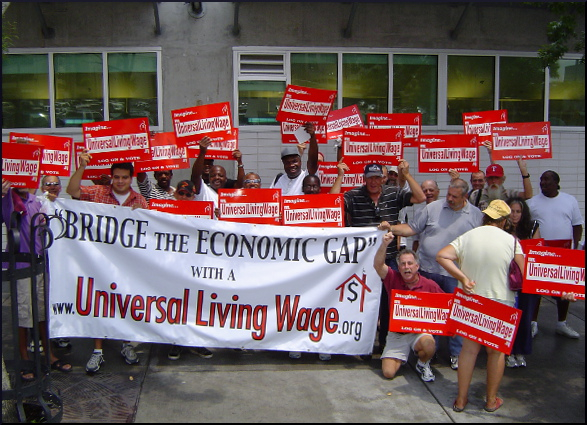
The situation in any city American city could be improved by adoption of the Universal Living Wage, which can end homelessness for over 1,000,000 minimum-wage workers, and prevent economic homelessness for all of 10.1 million minimum-wage workers.
Reactions?
Source: “Homeless outreach program working downtown, speakers say,” Missoulian.com, 09/28/11
Source: “New team reaching out to homeless in downtown Missoula,” Missoulian.com, 06/17/11
Source: “Missoula Restaurant Owners and Chefs: Tim France of Worden’s Market,” MakeItMissoula.com, 07/18/11
Source: “Missoula and beer: A history,” Missoula Independent, 04/20/10
Image by elias_daniel (Elias Gayles), used under its Creative Commons license.

The increasing violence against people experiencing 


As a document that people were eager to sign, the 
In 1.05-minute video “
Two years ago, the print publication High Country News published a significant story by Scott Bransford that spotlighted two California cities,
“This screams for Living Wages,” was the reaction of Richard R. Troxell on learning about a study about