
|


 |
House
The Homeless, Inc., an educational and advocacy group, was founded
in Austin, TX in 1989. House The Homeless considers all homeless
and formerly homeless individuals to be members of this 501 (c)(3) tax-exempt
non-profit Corporation. At no time does the makeup of our Board of Directors
ever fall below 60% of homeless and formerly homeless people.
Our mission
is Education
and Advocacy
surrounding
the issues of homelessness.
House
the Homeless Response to A Capital Metro Fare Hike
Read
Richard Troxell's latest whitepaper on homelessness in America -- Criminalization
of Homeless Cycle
A letter
from HTH's president, Richard R. Troxell:
|
February 2008
|
|
Dear Philip Mangano,
Executive Director, US Interagency Council on Homelessness:
|
|
The Ten Year Plans
coming out of American cities and being promoted by the federal
government in an effort to end “chronic” homelessness cannot do
so without addressing serious economic concerns of people experiencing
homelessness.
|
|
Obviously, there are
many aspects to homelessness. However, on one level we can divide
homelessness into two distinct economic categories: those who
work and those who are unable to work. Sustainable responses to
these economic categories can be characterized as establishing
“Livable Incomes.”
|
|
Presently, there are
over one million minimum wage workers experiencing homelessness
on an annual basis. Although working a full time minimum wage
job, a person cannot afford basic rental housing throughout urban
America. This is true even with the pending minimum wage of $7.25
per hour by July of 2009. Historically, Congress has embraced
the practice of only increasing the minimum wage to a level that
takes the American worker less than the economic distance necessary
to climb out of poverty. The current minimum wage structure does
not elevate the minimum wage worker to a level where they can
afford basic housing and the other core necessities of life. Decidedly,
the current Congressional approach only ensures their position
in the ranks of America’s homeless population. At the same time,
while these individuals meet the definition of “chronic” homelessness
with four or more instances of homelessness over a three year
period, none of America’s 10 year plans provide a solution to
this problem.
|
|
House the Homeless,
Inc. in Austin, Texas conducted a survey in December 2007
of 625 people experiencing homelessness. Astonishingly, 38% indicated
that they were currently working, yet still homeless. Upon releasing
the survey results (margin of error of 3.98%) we were notified
that in Atlanta, Georgia, 45% of their homeless population were
working at some point during the week. From Fredericksburg, VA,
we learned that 54% were working “at significant jobs.” In Austin,
we also posed the question: “Would you work a 40 hour week job
if you were sure it would pay you enough for basic food, clothing
and shelter [a living wage]?” The resounding affirmative response
was that 90.7 % said they would work 40 hours for a living wage.
Apparently, the work ethic is there but the wage is not.
|
|
Then there is the
situation affecting people who cannot work, but who in 2008 will
receive a government stipend in the form of Supplemental Security
Income, SSI, in the amount of $637.00 throughout the nation. This
is about half of the federal minimum wage and again wholly inadequate
to sustain independent living without being further heavily subsidized
with some kind of government supported “affordable” housing. Securing
housing in Washington, DC, Boston, MA or Santa Cruz, CA etc. in
the general housing market with an annual salary of less than
$14,000 or even half that per year is not possible.
|
|
In order to stimulate
the economy, specifically the housing industry, and to end “chronic
homelessness” for a significant portion of the nation’s homeless
community, we must:
|
|
1) establish the principle/formula
that by using existing government guidelines including the HUD
Section 8 formula and the HUD Standard that no one should pay
more than 30% of their income on housing, we can ensure that anyone
found by the federal government to be disabled will receive a
monthly stipend, (SSI), that enables them to afford basic food,
clothing, and shelter (including utilities) wherever that person
lives throughout the United States.
|
|
2) establish the principle/formula
that by using existing government guidelines including the HUD
Section 8 formula and the HUD Standard that no one should pay
more than 30% of their income on housing, we can permanently fix
the federal minimum wage and ensure that anyone working 40 hours
in a week will be able to afford basic food, clothing, shelter
(including utilities) wherever that work is done throughout the
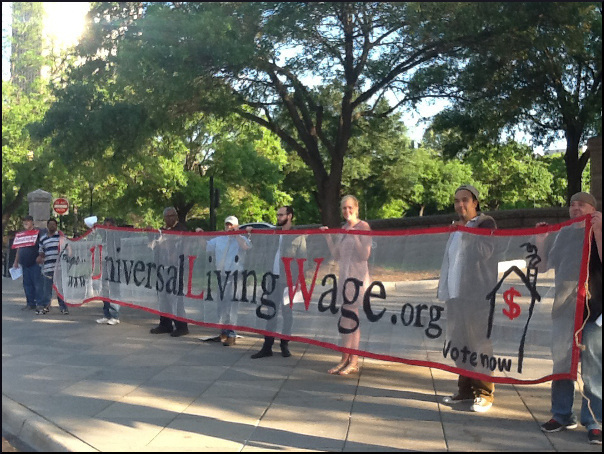
United States. See www.UniversalLivingWage.org to read
support statistics, the mathematical formula and the hardest asked
and answered questions found in our Facts
and Myths Section.
|
|
By indexing to the
local cost of housing, we ensure affordable housing throughout
the US. This simple approach mirrors US Military pay practices
(Base Housing Allowance).
|
|
We strongly encourage
the Interagency Council on Homelessness to adopt
our resolution and send the United States Congress and the US
Department of HUD the clear message that our focus on homelessness:
1) must be for all those experiencing homelessness, not just “chronic”
individuals, and 2) we must fix the Supplemental Security Insurance
program and the Federal Minimum Wage ensuring that all participants
(workers and those unable to work) can afford basic, food, clothing,
and shelter (including utilities) throughout the United States.
|
|
Sincerely,
|
|
Richard R. Troxell
President and Co-Founder, House the Homeless, Inc.
Universal Living Wage National Chairman,
National Coalition for the Homeless
Executive Committee Coordinator, Livable Incomes
|
|
Enclosures:
please find 1642 endorsing organizations consisting of businesses,
non-profits, faith- based organizations, and unions collectively
representing over 1,000,000 registered voters.
|
|
cc: President
George W. Bush, Senator Hillary Clinton, Senator Barack Obama,
ICOH-Nat, Reg, TX
|
| January 7, 2008
|
House
the Homeless Smashes Homeless Myth
|
| -- House the Homeless,
Inc. & Keep Austin Housed AmeriCorps Survey Report 1/7/08 |
|
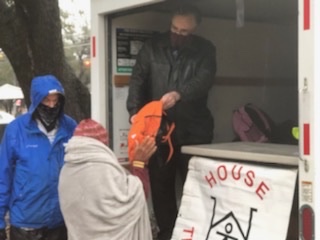
| On December 25, 2007,
House the Homeless and Americorps joined forces at the House the Homeless
8th Annual Thermal Underwear Distribution Party and conducted a survey.
Invited to participate were over 600 people who were provided life
saving thermal underwear and other winter clothing. 526 people experiencing
homelessness voluntarily responded to the survey. Note. A total of
19 additional surveys were discarded as being unintelligible. |
| Survey Results -- |
| Q: Do you work?
|
|
yes: 199
no: 327
non-responses: 0
37.8% are working.
Hours of work ranged
from 2-3 hours per day to 40+ per week
|
| Q: Do you want to
work? |
|
yes; 472
no: 48
6 non-responses
89.7% want to work.
Of those responding,
90.8% want to work.
|
| Q: What is keeping
you from working? |
|
Ranked in order of highest
importance:
health issues 62
can’t find work 60
disabled 56
no identification 50
economics/ low wages 21
“me” 18
transportation 17
criminal history/legal 16
need tools/clothes 10
lack experience/education 7
retired/age 6
weather 5
day care 4
new to area 4
personal problems 4
time 2
undocumented 2
ethical concerns 1
Note: Several people
cited more than one barrier.
|
| Q: Would you work
a 40 hour week job if you were sure it would pay you enough for basic
food, clothing, and shelter? |
|
yes: 468
no: 48
non-responses: 10
89% would work a 40 hour week for living wages.
Of those responding,
90.7% would work 40 hours for a living wage.
|
| Q: Do you get disability
benefits? |
yes: 100
no: 426
non-responses: 0
19% receive disability benefits. |
| Q: Do you have photo
ID? |
|
yes: 360
no: 164
non-responses: 2
31.2% need photo identification.
Of those responding,
31.3% need photo ID.
|
| Q: What is keeping
you from getting ID? |
|
Ranked in order of highest
importance.
1. need ID documents
to get photo ID 39
2. costs 38
3. application pending 8
3. no reason “me” 8
3. criminal record 8
4. don’t want to miss work 2
5. hopelessness 1
5. time 1
5. health issue (brain injured) 1
|
| Q: Are you a Veteran? |
|
yes: 121
no: 401
non-responses: 4
23% are Veterans.
Of those responding,
23.2% are Veterans.
|
| Note: 399 signed the
survey with either their first name, last name, or both. This was
optional. |
| Note:
Statistical significance of the survey: |
| The Austin Area Homeless
Task Force counted 4,000 people experiencing homelessness in the Austin
Area in 2007. With 526 homeless people surveyed, 13.1% of the population
was sampled. |
| If the population of people
experiencing homelessness is 6,000 then 8.76% of the population was
sampled. |
| Richard R. Troxell, President
of House the Homeless, Inc has declared these to be "Stunning results
with national implications!" He went on to say that "Although homeless,
over 38% of of these people are working at some point during the week.
This means that the Puritan Work Ethic is in tact. Furthemore, it
is now clear that what is lacking for many of them to end their homelessness
is a Living Wage Job." |
| Mr Troxell is also the
National Chairman of the Universal Living Wage Campaign. |
This web site
© copyright 2000--2008
by House The Homeless, Inc.
PO Box 2312, Austin, TX 78768. All rights reserved.
info@housethehomeless.org
This page last updated
July 8, 2008. Thank you for visiting
|